
An engineering degree is a four-year investment in skills, opportunities and future earning potential. But as artificial intelligence reshapes software development and raises expectations for entry-level engineers, the value of a degree increasingly depends on what students can build with what they learn. For applicants and families weighing the best colleges for computer science, the question is no longer just where to study engineering, but whether the education will prepare them for the work ahead.
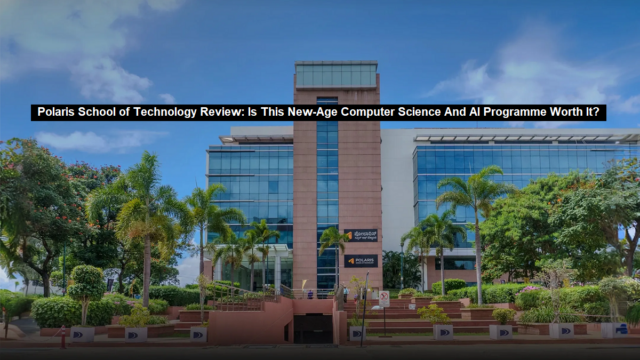
Polaris School of Technology, based in Bengaluru’s DivyaSree Technopark, takes up that question directly. Instead of saving practice for the end of the degree, it moves practice to the start. Students are coding from the first year, publishing open-source work that developers outside the college can review, and interning before their final year. The intended result is a graduate who arrives with a portfolio and workplace experience alongside the marksheet.
So, is this new-age CSE programme worth it? This review answers that by looking at six factors: admission, fees, co-curricular learning, industry immersion, global exposure and career prospects.
Admission: Selecting for Aptitude and Initiative
Polaris School of Technology offers a four-year UG programme in Computer Science and Engineering with specialisations in Applied AI Engineering, Product Management and Engineering, and Cloud and Big Data Engineering. The degree is awarded through Medhavi Skills University, a UGC-recognised university, with Polaris School of Technology serving as the industry-skilling partner.
Admission combines academic eligibility with an entrance assessment and an interview. Applicants need to have completed Class 12 from a recognised board with at least 60% marks, with Physics, Chemistry and Mathematics as required subjects. The selection process includes the Polaris Admission Test (PAT), although candidates with qualifying JEE or SAT scores can seek an exemption from the test.
| Admission requirement | Admission criteria |
| Academic qualification | Class 12 from a recognised board |
| Minimum marks | 60% |
| Required subjects | Physics, Chemistry and Mathematics |
| Standard assessment route | Polaris Admission Test (PAT) |
| JEE Main exemption | 90th percentile or above |
| JEE Advanced exemption | 90th percentile or above |
| SAT exemption | Score of 1,200 or above, taken within the previous three years |
| Final selection | Interview covering interests, motivation, projects and achievements |
| Application fee | ₹1,500 |
The exemption thresholds allow eligible applicants to bypass PAT, not the interview or the entire selection process.
The interview adds a dimension beyond exam performance. Applicants may need to discuss their interests, projects, motivation and reasons for pursuing technology. This approach suits a programme that expects students to learn through building and experimentation. Prior coding experience can help, but curiosity, initiative and the ability to explain one’s thinking are also relevant.
For applicants comparing the best colleges for computer science, this process shows that Polaris School of Technology looks beyond academic scores. The next question is what the programme costs.
Fees: Assessing the Investment
At Polaris School of Technology, tuition for the 2026–2030 batch comes to ₹26.09 lakh for Applied AI Engineering and Product Management and Engineering, and ₹31.09 lakh for Cloud and Big Data Engineering. Registration and admission charges add to these amounts, while accommodation, meals and transport are additional expenses.
Academic fee structure
| Fee component | Applied AI Engineering | Product Management and Engineering | Cloud and Big Data Engineering |
| Tuition across eight semesters | ₹26.09 lakh | ₹26.09 lakh | ₹31.09 lakh |
| Registration fee | ₹10,000 | ₹10,000 | ₹10,000 |
| Admission fee | ₹81,000 | ₹81,000 | ₹81,000 |
| Total academic charges | ₹27 lakh | ₹27 lakh | ₹32 lakh |
| Application fee | ₹1,500 | ₹1,500 | ₹1,500 |
| Hostel, meals and transport | Additional | Additional | Additional |
Scholarships provide some financial relief. The Mukul Rustagi Scholarship for Excellence offers awards of up to ₹8 lakh, while the Women in Tech Scholarship offers up to ₹5 lakh for eligible applicants. Other schemes include the Sourav Ganguly Young Leader in Tech scholarship, the Classplus Techpreneur Scholarship, the PST Merit Waiver and the PST Need-cum-Merit Waiver.
Read: How to Find Your Strengths and Use Them to Create a Rewarding Career
Co-Curriculum: Building Beyond the Syllabus
Polaris School of Technology places practical work alongside formal coursework. The programme describes more than 5,000 hours of hands-on coding across four years, with projects increasing in complexity as students progress. The aim is to move students from learning programming concepts to designing, testing and deploying systems.
The three specialisations lead towards different areas of technology, giving students a choice based on the kind of work they want to pursue.
| Specialisation | Core learning areas | Illustrative projects and skills |
| Applied AI Engineering | Machine learning, deep learning, generative AI, LLM engineering, AI infrastructure, MLOps and responsible AI | ML applications, RAG chatbots, fine-tuned models, AI agents and production ML systems |
| Product Management and Engineering | Software development, product thinking, user needs and technology-led problem-solving | Building software products, translating user problems into features and connecting technical decisions with product outcomes |
| Cloud and Big Data Engineering | Cloud platforms, data systems, infrastructure and large-scale computing | Data pipelines, cloud deployments and systems designed to process and manage data reliably |
Beyond the classroom, students take part in hackathons, technology events, student projects and open-source work. These activities develop collaboration, communication and the ability to solve problems without a ready-made answer, and they give students practice in presenting their work and responding to feedback. For a student considering CSE, this is a meaningful difference from a programme built primarily around examinations.
Industry Immersion: Bringing Work into the Degree
That practical focus carries into the workplace early. Internships begin in the second year, and the curriculum builds towards more complex projects and a final-year industry immersion capstone. Students apply technical concepts in practical settings instead of waiting until after graduation.
The curriculum itself is built with industry. Microsoft, Amazon Web Services and Google Cloud are PST’s industry partners. Their tools, credits and certification pathways are part of the coursework, so students learn on the platforms they will use at work.
Working professionals are part of the learning environment too. Students learn from faculty and mentors with industry experience, including engineers, technology leaders, CTOs and founders. Events have featured professionals from organisations such as Salesforce, Atlassian and Microsoft, alongside leaders connected to NVIDIA’s ecosystem through HCLTech.
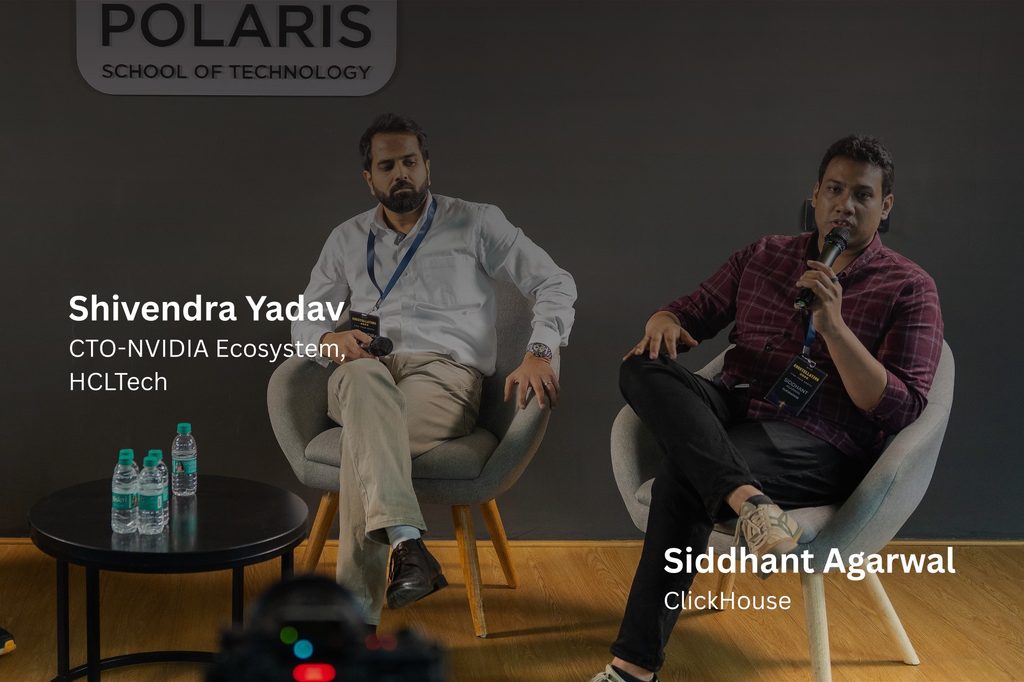
Polaris School of Technology hosts technology events such as AI Engineers Day, with sessions on AI tools and agent workflows, and Google for Developers events. Its industry-led hackathons put students in front of real deadlines: Vibeathon, a 36-hour AI product-building hackathon held with Replit, and Vibehack, a two-day event focused on building AI prototypes.
Global Exposure: Making Student Work Visible Beyond Campus
Global exposure at Polaris School of Technology is built largely around open-source participation. Students contribute to public software projects, work with external maintainers and build portfolios on GitHub. Because these contributions are public, developers from around the world can review them.
PST students have been selected for Google Summer of Code (GSoC), Linux Foundation LFX Mentorship, Summer of Bitcoin and Code for GovTech: 31 GSoC selections, 9 LFX selections, 4 Summer of Bitcoin selections and 2 Code for GovTech selections. Their contributions have involved international organisations, including MIT App Inventor and the Linux Foundation.
PST’s global exposure also extends into academia through ties with San Diego State University and California State University, Fullerton. These ties add an international academic dimension to the programme.
The value of this model lies in making work visible and giving students experience collaborating beyond their immediate surroundings. It can help students demonstrate their technical ability to prospective employers and build confidence working with unfamiliar teams.
Future Prospects: What Can Graduates Work Towards?
The three specialisations point towards different career pathways. Applied AI Engineering prepares students to pursue AI and machine learning roles; Product Management and Engineering connects software development with product-building responsibilities; and Cloud and Big Data Engineering focuses on the infrastructure and data systems behind digital services.
| Specialisation | Potential career pathways | Evidence that can strengthen a graduate’s profile |
| Applied AI Engineering | AI engineer, ML engineer, generative AI engineer, AI application developer | Deployed models, evaluated AI systems and production-oriented projects |
| Product Management and Engineering | Software engineer, product engineer, technical product roles | Working software products, user-focused problem-solving and cross-functional projects |
| Cloud and Big Data Engineering | Cloud engineer, data engineer, infrastructure engineer | Cloud deployments, data pipelines and reliable system design |
Students are already earning while they learn. The highest student stipend is ₹2 lakh per month, the average is ₹50,000 per month, and total student earnings exceed ₹1 crore. For students comparing the best colleges for computer science, this is what sets PST apart: coding, projects, internships and open-source work are part of the degree itself.
Conclusion: Is Polaris School of Technology Worth It?
Yes, for students who want to build from day one. Polaris School of Technology puts sustained coding, project-led learning, early internships and global open-source work into the degree itself, so students graduate with a portfolio, workplace experience and a public track record alongside the marksheet. Its three specialisations lead into AI engineering, product development and cloud and data infrastructure, so each student can go deep in the field they want to work in.
The cost is substantial, and the return is a graduate who has already built, shipped and worked alongside industry. For applicants seeking a practical, technology-focused education, PST stands out among the best computer science colleges by offering a clear direction and the means to follow it.
Frequently Asked Questions
1. What are the eligibility criteria for admission to Polaris School of Technology?
Applicants must have completed Class 12 from a recognised board with at least 60% marks and Physics, Chemistry and Mathematics as required subjects. Admission includes the Polaris Admission Test (PAT) and an interview. Eligible candidates with qualifying JEE or SAT scores can seek an exemption from PAT.
2. What is the role of Medhavi Skills University in the Polaris School of Technology UG programme in Computer Science and Engineering?
Medhavi Skills University, a UGC-recognised university, awards the degree, while Polaris School of Technology serves as the industry-skilling partner, delivering the programme’s applied learning component.
3. How does Polaris School of Technology help students build a portfolio before graduation?
Students work on projects that progress from programming fundamentals to specialised systems, alongside hackathons, internships and open-source contributions. Publishing work on GitHub also allows students to demonstrate their technical skills and contributions beyond academic grades.
4. What opportunities do PST students have to gain international experience?
Students can participate in global open-source programmes such as Google Summer of Code, Linux Foundation LFX Mentorship, Summer of Bitcoin and Code for GovTech. These opportunities involve working with external maintainers, contributing to established projects and collaborating beyond the campus community.
5. Does Polaris School of Technology have international academic partnerships?
Yes. Polaris School of Technology has academic ties with San Diego State University and California State University, Fullerton, two universities in California, United States. These ties add an international academic dimension to the programme, alongside the global exposure students already get through open-source programmes such as Google Summer of Code and LFX Mentorship.
6. Is Polaris School of Technology worth the investment?
Polaris School of Technology is designed for students seeking a practical, technology-focused engineering education. Its emphasis on sustained coding, project-based learning, internships from the second year and open-source contributions gives students opportunities to build demonstrable skills and workplace experience before graduation. The value of the investment also needs to be considered alongside the programme’s academic fees and additional living costs.